Define the question
Start with the decision that needs support. Set the scope, time frame and context to separate relevant information from noise.
Nonprofit association · Since 2012
We promote an intelligence culture that helps businesses, institutions and individuals ask better questions, assess sources and understand their environment.
Methods, learning and tools to support the analyst.
Our purpose
The Agencia de Coordinación de Inteligencia y Prospectiva (ACINP) works to make intelligence culture accessible to society and encourage its practical use, particularly in businesses and institutions.
Intelligence analysis turns scattered information into useful understanding of a specific question. Collecting data is only the beginning: analysts must assess its quality, recognise gaps and explain how they reach a conclusion.
About the association ↗From data to interpretation
Start with the decision that needs support. Set the scope, time frame and context to separate relevant information from noise.
Keep the origin and date of each piece of information. Distinguish facts, inferences and hypotheses. Look for evidence that could change your interpretation.
Examine relationships, sequences and places. Document your conclusions, their limitations and the questions that remain open.
Putting intelligence culture to work
The method adapts to the needs of each analysis. These applications show how to ask useful questions before looking for answers.
Which relationships between organisations, people and third parties help explain a business environment?
Ownership, connections and context to examine change, dependencies and potential conflicts.
Explore this field ↗What happened, in what order, and what information supports each statement?
Sources, timelines and hypotheses that can be revisited as new information emerges.
Explore this field ↗How are the transactions, entities and people involved in a case connected?
Visual analysis to support the examination of transactions and document their context.
Explore this field ↗Which overlaps and sequences deserve a closer review?
Connections between participants, payments and events to assess alternative explanations.
Explore this field ↗Which identities, infrastructure and events form part of an incident?
Organising technical and chronological information to document an investigation.
Explore this field ↗What does each finding establish, and how does it relate to the remaining evidence?
Connect findings, documents and events to explain the case.
Explore this field ↗Start here
Explore the discipline, practise the method and discover tools that help organise an analysis.
Define your intelligence question, assess the sources and communicate the limits of your findings.
Try the five questions ↗Explore a browser-based workspace for organising information and examining relationships.
Explore Yappari One ↗Learn about the nonprofit association behind this initiative and its mission to promote intelligence culture.
About ACINP ↗Your first exercise
Apply them to a topic you know before opening a tool.
From method to practice

A relationship map helps organise people, entities and events. Together with timelines and documentation, it provides a way to explore a case and explain the analyst's reasoning.
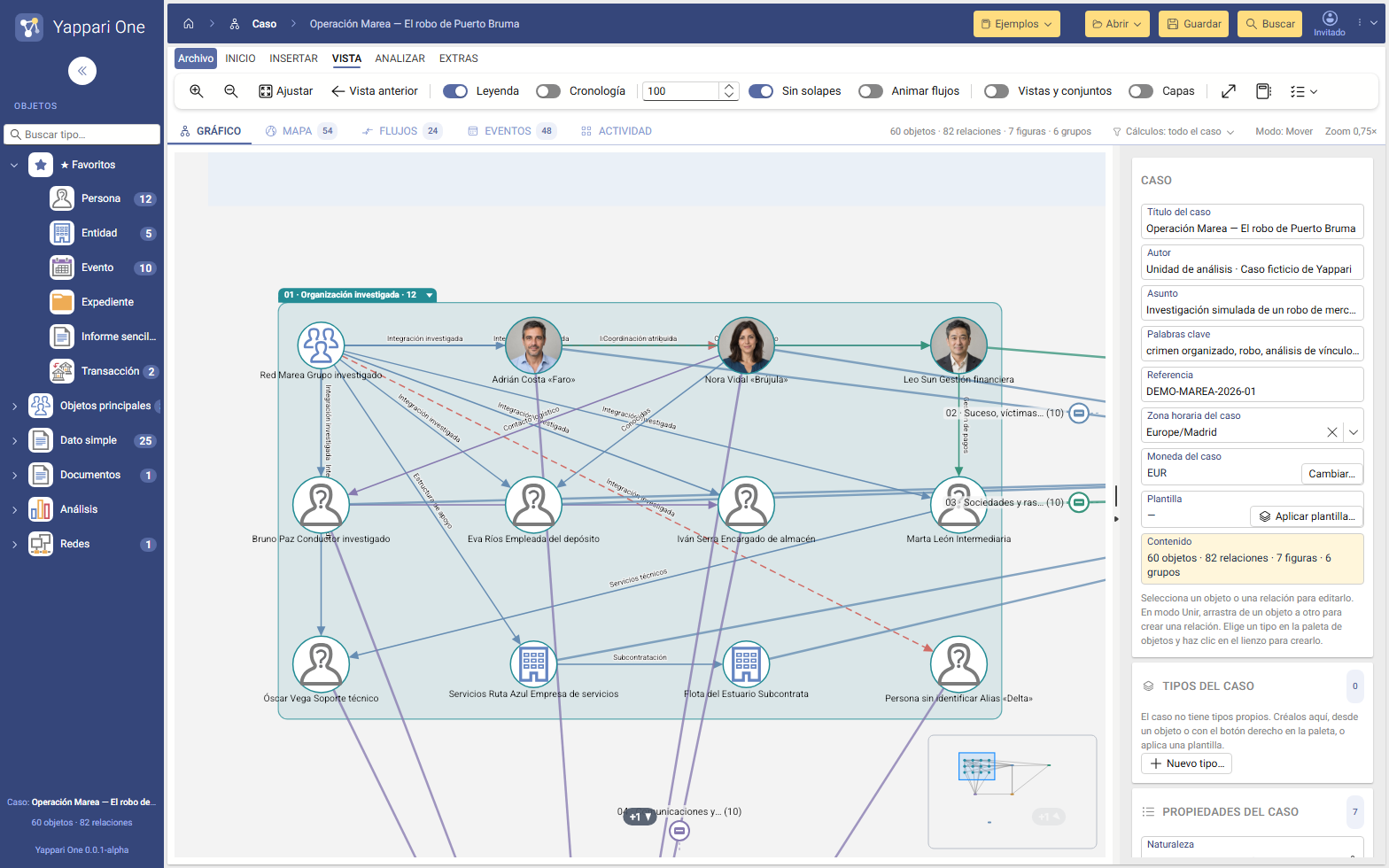
Yappari's analysis workspace is in the browser. Access the application to work with the information and relationships in your cases.
Open Yappari One ↗Define the question, gather the sources and examine relationships before drawing a conclusion.
Explore the method ↗Intelligence with purpose
ACINP is a nonprofit association established in 2012 and registered under number 600885 in Spain's National Register of Associations.
Our purpose is to promote and spread an intelligence culture that leads to tangible applications for businesses and institutions.
